
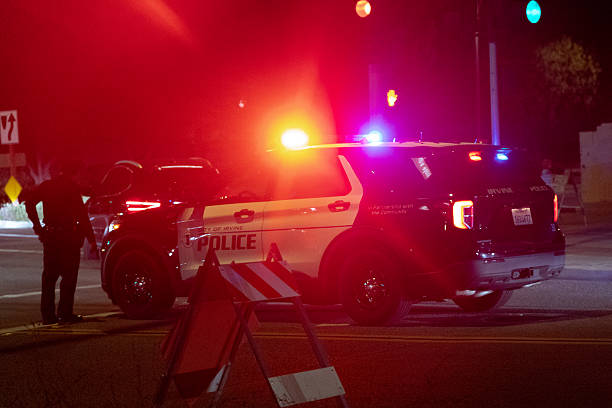
The evening of April 14, 2026, along a familiar stretch of Maryland Route 260 in Calvert County, became the scene of a heartbreaking tragedy that has left the Chesapeake Beach community in mourning. Amanda Regan, 37 years old, lost her life in a devastating single vehicle crash on eastbound Maryland Route 260, also known as Chesapeake Beach Road, near the East Mount Harmony Road overpass.
According to the Maryland State Police, the fatal crash occurred around 9:07 p.m. Investigators say Regan was driving a Jeep Wrangler when, for reasons still under investigation, the vehicle failed to properly navigate a left hand curve in the roadway. The Jeep crossed into the eastbound lanes, struck a guardrail, and then continued off the roadway before coming to rest against a tree.
Despite the rapid response of emergency personnel and troopers from the Maryland State Police Prince Frederick Barrack, Amanda Regan was pronounced dead at the scene due to the severity of the crash. As the Maryland State Police Crash Team continues to investigate the circumstances surrounding the crash, the Chesapeake Beach community is left heartbroken and grieving, struggling to process the sudden loss of a woman whose life ended in a single moment on the road.
The Crash A Left Hand Curve and a Guardrail
The crash occurred around 9:07 p.m. on eastbound Maryland Route 260 near the East Mount Harmony Road overpass. Route 260 is a major roadway in Calvert County, connecting the communities of Chesapeake Beach, Owings, and Dunkirk to the broader Washington DC and Baltimore metropolitan areas. At 9:07 p.m., darkness would have been complete. Streetlights on rural highways are sparse, and headlights provide only limited visibility. A left hand curve at night requires careful attention, reduced speed, and precise steering.
Investigators say Regan was driving a Jeep Wrangler when, for reasons still under investigation, the vehicle failed to properly navigate a left hand curve in the roadway. The phrase “failed to properly navigate” is significant. It indicates that the Jeep did not follow the intended path of the road. The driver may have been speeding, may have been distracted, may have been impaired, or may have experienced a medical emergency or mechanical failure. The investigation will seek to determine which of these factors, or combination of factors, caused the Jeep to leave its lane.
The Jeep crossed into the eastbound lanes. This detail is notable because Regan was already traveling eastbound. Crossing into the eastbound lanes suggests that the Jeep may have crossed the center line from the westbound side, or that the description is clarifying that the Jeep crossed from one part of the eastbound roadway to another. The original article is slightly ambiguous, but the key point is that the Jeep was not where it should have been. It struck a guardrail. Guardrails are designed to absorb impact and redirect vehicles back onto the roadway. In this case, the guardrail did not stop the Jeep. The vehicle continued off the roadway before coming to rest against a tree. A tree is immovable. When a vehicle strikes a tree at speed, the outcome is almost always catastrophic.
The Severity of the Crash Death at the Scene
Despite the rapid response of emergency personnel and troopers from the Maryland State Police Prince Frederick Barrack, Amanda Regan was pronounced dead at the scene due to the severity of the crash. The phrase “rapid response” indicates that police and EMS arrived quickly, but no amount of speed could have saved her. The injuries she sustained in the crash were unsurvivable. There was no hospital transport, no race to an emergency room, no chance for doctors to fight for her life. She died on Route 260, alone in her Jeep, far from home.
The fact that the Jeep came to rest against a tree explains the severity of the injuries. A tree does not give way. It does not crumple or absorb impact like a guardrail or a barrier. It stops the vehicle instantly, subjecting the occupants to extreme deceleration forces. In a Jeep Wrangler, which has a boxy shape and a higher center of gravity than a passenger car, the forces of a tree impact can be even more severe. The vehicle may have crumpled around the tree, crushing the occupant compartment.
The emergency personnel who arrived at the scene faced a difficult task. They had to confirm death, secure the scene, and begin the process of documenting the crash for investigation. They also had to notify the coroner and arrange for the removal of Regan’s body. These are the grim realities of law enforcement and emergency medical work. The troopers from the Prince Frederick Barrack will carry the memory of this crash with them.
The Victim Amanda Regan, 37
Amanda Regan was 37 years old. She was a resident of Chesapeake Beach, Maryland, a small waterfront town in Calvert County on the western shore of the Chesapeake Bay. Chesapeake Beach is a community of approximately 6,000 residents, known for its boardwalk, its beach, and its small town charm. Amanda was likely a familiar face in this community, someone who shopped at local stores, attended community events, and had friends and neighbors who cared about her.
The original article does not provide biographical details about Amanda her occupation, her family structure, her hobbies, or her dreams. That information will emerge in the coming days as family members speak to the media and as obituaries are published. What is known is that she was driving a Jeep Wrangler on Route 260 on the evening of April 14, and that she did not survive the crash. She was 37, an age at which many people are in the prime of their lives, raising children, building careers, and planning for the future. All of that is gone now.
The Investigation Maryland State Police Crash Team
The Maryland State Police Crash Team continues to investigate the circumstances surrounding the crash, working to determine what caused the vehicle to leave the roadway and whether any additional factors may have contributed to the tragic incident. The Crash Team is a specialized unit of the Maryland State Police, trained in advanced collision reconstruction techniques. They will analyze skid marks, vehicle damage, road conditions, and any available surveillance footage. They will also examine the Jeep Wrangler for mechanical issues such as tire failure, brake failure, or steering problems.
The investigation will also consider whether speed was a factor. Left hand curves require drivers to slow down. If Regan was traveling above the posted speed limit, she may have been unable to maintain control of the vehicle through the curve. The investigation will also consider whether impairment played a role. Toxicology tests will be performed on Regan’s remains to determine whether alcohol or drugs were present in her system. These tests are standard in fatal crash investigations, and the results may take weeks to be finalized.
The investigation will also examine whether external factors contributed to the crash. Was there debris on the roadway? Was the guardrail properly maintained? Was the curve properly signed and marked with reflective tape? These questions are important for determining whether any entity other than the driver bears responsibility for the crash.
The Road Closure More Than Three Hours
Following the incident, eastbound lanes of Route 260 were closed for more than three hours as investigators conducted an on scene examination and reconstruction of the crash. Road closures are necessary for crash reconstruction. Investigators must measure distances, photograph evidence, and document the position of the vehicle before anything is moved. A single mistake could compromise the entire investigation.
Assistance was provided by the Calvert County Sheriff’s Office and the Maryland Department of Transportation State Highway Administration. The Sheriff’s Office helped with traffic control and scene security. The State Highway Administration helped manage traffic and secure the area. This multi agency response is standard for serious crashes on state highways.
For drivers who were forced to detour around the crash, the closure was an inconvenience. For Amanda Regan’s family, the closure was irrelevant. Their loved one was dead, and no reopening of lanes could change that.
The Community Chesapeake Beach Mourns
The Chesapeake Beach community is left heartbroken and grieving following the sudden loss of Amanda Regan. Family, friends, and loved ones are struggling to process the sudden loss, remembering her life while facing an unimaginable tragedy. The suddenness of her death is one of the most difficult aspects for her loved ones to bear. There was no long illness to prepare for. No gradual decline. No chance to say goodbye. One moment she was driving on Route 260. The next moment, she was gone.
In the midst of sorrow, the community now stands together in mourning, offering prayers, support, and condolences to those closest to her. That is the work of a community in tragedy. Neighbors bring food. Friends show up at the family’s home, not to say anything profound but simply to be present. Churches hold vigils. The community cannot bring Amanda back, but it can surround her family with love.
The loss has left a deep void, as many reflect on how quickly life can change in a single moment on the road. That reflection is both painful and necessary. Life is fragile. A routine drive to work, to the store, to a friend’s house can end in tragedy. The curve on Route 260 that Amanda Regan failed to navigate is still there. Other drivers will take that curve tonight, tomorrow, and every day. Some of them will think of Amanda. Some will slow down. Some will be more careful. That is the only legacy that can come from such a tragedy.
The Dangers of Rural Night Driving
The crash that killed Amanda Regan highlights the dangers of driving on rural roads at night. Unlike urban highways with continuous lighting and wide lanes, rural roads like Route 260 have limited lighting, sharp curves, and narrow shoulders. Animals can appear suddenly. Debris can be hidden in darkness. A moment of inattention or a moment of excessive speed can have fatal consequences.
Safety experts recommend that drivers reduce speed at night, especially on unfamiliar roads. They recommend keeping headlights clean and properly aimed, avoiding distractions such as phones, and never driving while impaired by alcohol or drugs. They also recommend wearing seat belts at all times, as seat belts are the single most effective way to survive a crash. The original article does not specify whether Amanda Regan was wearing a seat belt. That detail may emerge in the investigation.
For drivers who must navigate left hand curves at night, the key is to slow down before the curve, not during it. Braking in the curve can cause the vehicle to lose traction. The driver should look through the curve to where they want to go, not at the guardrail or the tree. These techniques can save lives. But no technique can save a driver who is speeding, distracted, or impaired.
Holding Onto Memories
As the investigation continues and the community mourns, the family and friends of Amanda Regan are left to do the hardest work of all. They must hold onto their memories of her while also confronting the reality of her death. They must grieve her loss while also supporting one another. They must be patient while the investigation proceeds, even though every day without answers feels like an eternity.
Amanda was 37. She had decades of life ahead of her. She had dreams that will never be fulfilled, love that will never be given, moments that will never be experienced. That is the unspeakable tragedy of a sudden death. It is not just the loss of what was. It is the loss of what could have been.
But what was still matters. The 37 years that Amanda lived, the people she loved, the joy she brought, the memories she created these things are not erased by her death. They remain. They are the inheritance of everyone who knew her. And as long as those memories are held and shared and cherished, Amanda Regan will never truly be gone.
Conclusion A Life Lost on a Familiar Road
The death of Amanda Regan at age 37 in a single vehicle crash on Maryland Route 260 is a tragedy that has left the Chesapeake Beach community in mourning. A woman is dead. A family is shattered. An investigation is working to determine what happened. And a community is left to reflect on how quickly life can change in a single moment on the road.
The Maryland State Police Crash Team will continue its work. The medical examiner will complete its report. But none of that will bring Amanda back. None of that will fill the void left by her absence. Only time, and love, and memory can do that work.
As Chesapeake Beach mourns, the community stands together in mourning, offering prayers, support, and condolences to those closest to her. Rest in peace, Amanda Regan. You were loved. You will be missed. And your memory will live on in the hearts of everyone who knew you.
Leave a Reply